Showing posts with label What Went Wrong. Show all posts
Tuesday, May 17, 2011
What Went Wrong - Innocent Life: A Futuristic Harvest Moon
Waaaay way back in the beforetimes of 2006, Natsume, in their infinite wisdom, decided that simple farming games just weren't cool anymore. There has to be some sort of hook, some change-up to the series, and they decided on two different methods. Two methods that couldn't be further from each other, and on different platforms to boot, because, well, obviously that's how you'll get an idea of what people want. Anyways, the method that Nintendo DS owners got was a little game that you might have heard of called "Rune Factory: A Fantasy Harvest Moon". (As a sidenote: Rune Factory: Oceans is getting localized with a slightly different name for PS3/Wii.)
Rune Factory took the concept and added a few easy additions without really taking much away. You don't really get a pet, which is a sort of a staple of the series, but there's a proper replacement in the form of tamable monsters. That would be the other big addition, is Monsters and the combating thereof. All around the area in Rune Factory, are caves that you can explore with monsters inhabiting the interior of that you can kill for experience (Rune Factory is a bit more of an RPG than normal) or tame to take care of on your farm. There's also a few more possible romance options than normal. The point here is that they didn't really cut out a lot of stuff and, if anything, made it a bit deeper.
Innocent Life? Not....not so much. And to explain that, I am basically explaining my problem with the more 'narrative' of the installments of the Harvest Moon franchise. Even though Innocent Life isn't what I would call one of the 'narrative' games, in that it certainly feels loose enough where you can do whatever and I imagine though the goal is clear, it's not concrete. But, essentially as I've explained before, Harvest Moon as a series is just something you play when you want to chill out and grow some plants, pet some animals and hit on some local ladies. No real goal is needed, so when one is pushed on you, it kinda ruins the whole reason you're playing.
Let's cut to the chase that is possibly my biggest "ehhhhh" thing with the game: You're a robot. So right there, the ability to romance people in the town is completely excised. And honestly? Human interaction period is mostly optional at best. Through the whole game, I imagine you need to talk to about a dozen people, if that. Even though nobody knows you're a robot (at first) absolutely nobody is interested in you beyond saying, "Hey, there's that poor kid stuck at the Easter Ruins." The characters, in fact, aren't generally interested in much, really.
So, let's move on to the overall story here with that, since the other characters in the game are pretty vital to what is, in all honesty, a pretty terrible backstory. Now, you know that you play a robot, but I haven't told you why just yet. And the reason is simple: Everyone on the fucking island is too lazy to save their own life. Essentially, everyone on the island knows of the 'legend' that the lands became un-farmable without high technology because the Spirits of the island became angry with the people there. And that only by farming the Easter Ruins properly, with a human touch and care, could they be appeased. So what do they do?
Absolutely fuck-all.
To the point where Dr. Hope Grain (ugh.) goes, "Hey, this is pretty bad, the volcano looks like it might erupt and if that happens we're all going to die, I should probably do something." But given that he is old and frail, and apparently completely unable to inspire others to do what they need to do, he just builds a robot to do it for him. A robot that he programs to be a pure, innocent being, like a child, who will grow and flourish as the crops he plants does.
It's....not a very good backstory. And Innocent Life isn't that good of a game, either. It's a fair game with good points, I'll grant it that, but the sum of the frustrations with it simply outweigh the good.
Quite simply, the game is not at all built to be anything but a game where you farm and/or raise animals (eventually). The townspeople offer nothing in the way of entertainment or insight or bond-growing, and even when you can go about and collect other materials, there's not that much plentiful and they barely even sell. The wild food you can gather after you buy a scale pack has to grow back, even, and will sell for even less until they're fully grown again. You can't even fish until Summer since you have to talk to the Fisherman to fish. Not even in a sense where you have to get a fishing pole from him to go out and fish on your own. But in the sense that you have to talk to him, get a pole and then you give it back.
The point is that there is very little to do if you are not farming. Even cooking doesn't bring a lot to the table since it doesn't even require things to cook, since they're from your apparently magical ever-full refrigerator. Which, I guess, is fine. The farming is fine in this game, especially when you start unlocking things to make it easier to work with the rather large field you can eventually have. Rail systems you can set up to put harvested crops onto so you can more easily take them to your shipping pod, for one, is a really neat idea, if not perfectly executed.
This reliance on the farming aspect makes it perfectly simple to pinpoint the exact moment where the game goes fully wrong: Monday, 8th Day of Summer. You see, weather has often been a key player in the Harvest Moon games; you got your sunny days, your rainy days (snowy in winter), and then your calamity days. The Calamity days are when it's storming so harshly that you can't really do much aside from wonder why Natsume thought this was a good idea. It also does bad things to your crops, which is what I'm getting to here. The 8th day of Summer, as far as I can tell, is always going to be a storm day. So, if you've been doing what you're supposed to do and you've got a bunch of stuff planted, well, there goes your money.
And Innocent Life is a bit worse at it than any other game in the series, as far as I can tell. I more or less lost 4 or 5 plants per main crop (I usually do plots of 9 of the main stuff) and everything else was decimated or completely removed. At that moment, when I saw that, I knew there was just nothing more I could experience in the game to make up for it. As I explained to a friend, it's an excellent Robot simulation game, in the sense that robots really don't do a lot to spice up life or have fun. So I will say that Innocent Life is clear in its goal and handles it well, but that doesn't make it interesting for anyone who plays Harvest Moon for the overall experience and not just the farm sim part.
As I said before, there's a lot of good in the game to be found by anyone who plays it. The locales and areas all look absolutely wonderful. Houses are large and detailed nicely, if feeling a bit out-of-scale at times, and there is a lot of area to explore before you realize there's really no point unless you're trying to treat your eyes. The music is non-invasive and mostly fitting, though quite forgettable. (I had noticed someone on a board somewhere said that to really hear the music, you had to use headphones, but never got around to it.) And as a game, it plays fairly simply and nicely, even if there's hardly a good game to pair it to.
Also, you get a dune buggy. (Pictured a few pictures above)
But all in all, while interesting and while exploring an area where a Harvest Moon game genuinely has merit to be attempted in, it's a flawed game that will eventually convince you that you don't really like it, despite how you may feel playing that first season. Which is a little disappointing, given that a Futuristic Harvest moon could have been so much more. Perhaps they'll attempt it again sometime, but in the right way. We can always hope.
Saturday, May 7, 2011
What Went Wrong - Chrono Trigger DS Part 2
When we last left you, I had just got finished explaining how the new script, new playable areas, and the new story accompanying them all sucked. And boy did they. Once again, I'll put up the warning here, that this post, especially this post, will be filled with spoilers from both Chrono Trigger and Chrono Cross, so be warned before you read.
So, to start, I have to explain something so I can explain something else, so I can resume making my point. Sigh. The hard part about this is that I'm writing this to people who either A) Have played both games (or the majority of both, at least), or B) Don't care about spoilers, so either way, it seems like a lot of unnecessary typing, but oh well. This is therapeutic, and for all the A people out there, hopefully I can reinforce opinions or even sway them.
Now, I guess the point I'll start at here is just how important Schala becomes to the entire, overall story of both games. Schala, for all intents and purposes, honestly doesn't matter much if you just play Chrono Trigger. She's a tragic character, as she basically exists to be the ultimate, tortured martyr. In the Kingdom of Zeal, when her mother, appropriately named Queen Zeal, starts going crazy because of the influence Lavos has over the world to those with magical ability, Schala is tasked with using her ability to keep a machine going that actually taps into Lavos' energy. Which...for a kingdom of knowledge and power, isn't really a smart move. But influence of the all-powerful, blah blah, whatever.
Anyways, Schala's sob story continues as she tries to fight against her mother, sort of, but being a pacifist, or something, kind of ruins that. So she just gets dragged along as the plan gets more and more dangerous and they decide to move the machine closer to Lavos to get moooooreeee powerrrr. And eventually when shit gets real, she's the one who ends up taking the fall, leaving one to imagine that she just got eaten by Lavos or died or something. The end.
But this is where Cross comes in. I'm not going to beat around the bush here. The girl pictured above is Kid, the second main character of Chrono Cross, and no matter what she looks like, she's actually a clone of Schala. She's actually a clone of Schala. A daughter-clone no less. You see, when Schala is left with Lavos, she actually gets absorbed by him, rather than just being lunch. And when Crono and Co. defeated Lavos, instead of, well, dying, he instead turns into the Boss of Chrono Cross, the Time Devourer. Somehow.
When Serge, the main character of Cross, dies as a child (which is what sets Cross' events into motion by creating an alternate universe in which, well, he doesn't die), the Time Devourer, or more aptly, the part that is Schala, births the child-clone that is Kid six years prior to him dying, as a means to give Serge an ally to stop himself from dying. I.....yeah. Let's just move on now.
The point is, Schala's role extends just like that to not only Trigger in ways that actually show up more than not now, but creates that bridge that is supposed to make us all go, "Oh, hey, it is a sequel, totally and completely!" But, of course, this is all gripes pointed towards Chrono Cross, which, as I have established, has very little to do with Chrono Trigger. (Snap!)
So where am I going with all this? I'm going to the all-new boss that leads to the all new ending exclusive to the DS version of Chrono Trigger. After you clear the Time Vortex areas (meaning you have to sit through that scene with Dalton) a new sparkle will open up at The End of Time, and the old man will warn you to stay the hell away, because this dude ain't messing around. So when you inevitably go, "Pshaw, you're old, what do you know" and warp there, guess who the new boss is?
The Dream Devourer. An early form of, wait for it, the Time Devourer.
You know, the thing responsible for Chrono Cross and.....you know what, just forget it. Obviously, we've established that Lavos just doesn't die. Since when he did die, he just got better. Italics. Anyways. For what happens here, I'm just going to post, verbatim, the private message I sent to somebody on Penny Arcade when they asked me about what happened in the new ending right after I'd gotten it.
This is why Chrono Trigger DS is not the definitive version of the game.
So, to start, I have to explain something so I can explain something else, so I can resume making my point. Sigh. The hard part about this is that I'm writing this to people who either A) Have played both games (or the majority of both, at least), or B) Don't care about spoilers, so either way, it seems like a lot of unnecessary typing, but oh well. This is therapeutic, and for all the A people out there, hopefully I can reinforce opinions or even sway them.
Now, I guess the point I'll start at here is just how important Schala becomes to the entire, overall story of both games. Schala, for all intents and purposes, honestly doesn't matter much if you just play Chrono Trigger. She's a tragic character, as she basically exists to be the ultimate, tortured martyr. In the Kingdom of Zeal, when her mother, appropriately named Queen Zeal, starts going crazy because of the influence Lavos has over the world to those with magical ability, Schala is tasked with using her ability to keep a machine going that actually taps into Lavos' energy. Which...for a kingdom of knowledge and power, isn't really a smart move. But influence of the all-powerful, blah blah, whatever.
Anyways, Schala's sob story continues as she tries to fight against her mother, sort of, but being a pacifist, or something, kind of ruins that. So she just gets dragged along as the plan gets more and more dangerous and they decide to move the machine closer to Lavos to get moooooreeee powerrrr. And eventually when shit gets real, she's the one who ends up taking the fall, leaving one to imagine that she just got eaten by Lavos or died or something. The end.
But this is where Cross comes in. I'm not going to beat around the bush here. The girl pictured above is Kid, the second main character of Chrono Cross, and no matter what she looks like, she's actually a clone of Schala. She's actually a clone of Schala. A daughter-clone no less. You see, when Schala is left with Lavos, she actually gets absorbed by him, rather than just being lunch. And when Crono and Co. defeated Lavos, instead of, well, dying, he instead turns into the Boss of Chrono Cross, the Time Devourer. Somehow.
When Serge, the main character of Cross, dies as a child (which is what sets Cross' events into motion by creating an alternate universe in which, well, he doesn't die), the Time Devourer, or more aptly, the part that is Schala, births the child-clone that is Kid six years prior to him dying, as a means to give Serge an ally to stop himself from dying. I.....yeah. Let's just move on now.
The point is, Schala's role extends just like that to not only Trigger in ways that actually show up more than not now, but creates that bridge that is supposed to make us all go, "Oh, hey, it is a sequel, totally and completely!" But, of course, this is all gripes pointed towards Chrono Cross, which, as I have established, has very little to do with Chrono Trigger. (Snap!)
So where am I going with all this? I'm going to the all-new boss that leads to the all new ending exclusive to the DS version of Chrono Trigger. After you clear the Time Vortex areas (meaning you have to sit through that scene with Dalton) a new sparkle will open up at The End of Time, and the old man will warn you to stay the hell away, because this dude ain't messing around. So when you inevitably go, "Pshaw, you're old, what do you know" and warp there, guess who the new boss is?
The Dream Devourer. An early form of, wait for it, the Time Devourer.
You know, the thing responsible for Chrono Cross and.....you know what, just forget it. Obviously, we've established that Lavos just doesn't die. Since when he did die, he just got better. Italics. Anyways. For what happens here, I'm just going to post, verbatim, the private message I sent to somebody on Penny Arcade when they asked me about what happened in the new ending right after I'd gotten it.
Essentially, to get the new ending, you have to go through all three "Time Vortex"es which are new dungeons that take existing palettes and throw them together in sequences of five. Then there's a couple new areas (one or two 'zones') with Uber-gear, and then a Boss fight of Crono, Marle, or Lucca clone.I'll admit, the fact that it was called the Dream Devourer escaped me, as before tonight, I thought it was the Time Devourer. But....technically, it is, so fuck semantics. But that is the new ending. I don't think I can explain it anymore than that. So I'm just going to leave it at that.
Oh, and Dalton. Yeah, you fight Dalton right before the Crono clone in 1000 A.D. When you win, he basically says "I'm so mad, I'm going to go to Porre and raise an army to Destroy Guardia! That'll learn ya!" So he's a cheap plot device, basically.
So after the TVs, you go to the End of Time and Gaspar goes "Oh, hey, so the bucket leads to somewhere new, and it's pretty dangerous." So when you select the bucket, you have the option of going to Time's Eclipse, where you fight the Time Devourer (Dun dun dun) which is a Red Lavos with Schala on top.
When you get there, Magus is there (Future Magus, basically, so he's there even if you have Magus. Or....even if you 'killed' Magus) and goes, "I'm from the future after Lavos was destroyed, and I'm here to face the greater evil, you don't need to get in my way." So, you can follow him and watch as he gets his ass handed to him by the Time Devourer, then you engage in battle.
The Time Devourer is pretty rough, even with uber-gear. But he's entirely beatable.
Once you beat him, Magus comes back and Schala goes "I've become so terrible, I have to send you people away from this place." So the party gets teleported away. And Magus goes, "Schala, I have to save you, wahwahemo" and Schala goes "You can't save me, Janus, you've done all you can do and now you just have to make a new life for yourself, abloo ablooemo" and Magus goes "Noooooooooo emo" and gets teleported away.
Then there's a black screen and Magus goes "So my efforts were useless. Fine then, I'll do something else, whatever. Not like I needed a driving force in my life. Maybe I'll just wait til I DIE" And then he's in a forest and goes, "Oh no, I've lost my memory! But I remember that I was trying to find somebody! Even though I don't know anything at this point, I will search for this person!" and then walks off.
END OF GAME.
This is why Chrono Trigger DS is not the definitive version of the game.
Labels:
Chrono Trigger,
DS,
Dumb,
Games,
I hate Spring,
Rage,
Rant,
What Went Wrong
Friday, May 6, 2011
As Promised: What Went Wrong - Chrono Trigger DS Part 1
I would like to state two things at the very forefront here before I get started. The first being that Chrono Trigger is one of my all-time favorite games, with the second being that said fact might leave me a bit biased to the changes in the DS version. Might. I would like to think that my opinions here are based on, well, common sense, but I am all for admitting that that might not be the case. And I would also like to point out that this post will be heavily spoiler-laden for Chrono Trigger and Chrono Cross both by nature, since some of the flaws have to do with the lack of connection between the two games, and Squeenix desperately trying to change that.
It's hard to pick where to start, honestly, as stepping into the mire of the Cross and Trigger mixed story is something akin to....something that I can't quite think of. It's not pleasant, I assure you, and it's confusing and distracting all at the same time. Or maybe I'm just bad at analogies. Regardless, I guess the most important mis-step that Chrono Trigger DS takes is the added story that is supposed to bridge CC and CT together more cohesively, especially since it fails almost categorically. But the first thing one is likely to notice as different and in a bad way would likely be the new script.
While most of the script changes are harmless at worst, some of the changes seem decidedly bad, and others just disjointed and short-sighted. The most obvious example is Frog who, in the original, spoke with the only Olde English accent to be found in the game. While out of place, especially in a setting where that accent would be expected, yet nowhere to be found, you could always chalk it up to the fact that he is cursed to be a walking frogman. Who knew if it was part of that or not, aside from the cutscenes in the game focusing on Glenn's backstory.
Yet, in the new version of the game, rather than flowering up the entire 600 A.D. script portion, they gave Frog the same accent as everyone else. Which, alright, it's fine, maybe they just didn't want to do era-specific accents, that's okay. Except they kept the pre-historic accents. Not only that, but they made them a touch bit worse, I'd say! I guess it's a bit of a nit-pick, but like I said, it's a bit short-sighted, and gives the impression that they approached the script in parts, rather than a whole. Definitely not the choice I would have made, at least.
But likely the most annoying part of the new script would be 600 A.D.-centric as well, if just focused in a different area. For the unfamiliar, there's a war in the 600 A.D. era between the regular humans and the monsters of the time, lead by Magus, a powerful warlock, and his top three generals, Ozzie, Flea, and Slash. (No, not making that up.) Admittedly, the war isn't too focused on, besides a few parts, but there is a rather great section of the game where the party confronts Magus to take him down. Since that's what the rag-tag band of heroes is wont to do.
While Magus is a fairly uncommon word, it's not that hard to check out what it means and get why he's referred to as such. Mainly because he is a fucking warlock. But Squeenix, in their infinite wisdom decided that 'Magus' wasn't a cool enough title for a warmongering, all-powerful wizard and decided to change his title in the remake. The new title? 'The Fiendlord'. Which....I guess is explanatory enough in itself as well, and it's not like he's not referred to as Magus at all, but we're entering Saturday Morning Cartoon territory with that, here. I just can't take anything seriously in any sense when I'm plotting and/or training to take down someone who unironically walks around calling himself 'The Fiendlord'.
The next issue, which is easy enough to address quickly, is the fact that every new gameplay addition is completely and totally arbitrary. The pictured above is the monster arena where you can train a monster to, I guess, fight other people's monsters. Of course, you can only set a routine thing once a day, and there's absolutely no joy, no reward, or anything in doing so, unless you have someone constantly around you who is also interested in this incredibly poorly-thought-out mechanic. I lost interest quite quickly, and can't rightly figure out how one wouldn't, but am prepared to invoke the 'Different strokes' clause on that.
Moreover, that would be the least offensive part of the new additions. The Lost Sanctum, which is often called "Fetch-Quest Mountain", is exactly what the fan-given moniker would suggest. I believe the total count of times you have to go up and down the entire mountain, which includes at least five mandatory fights with each up and down set, is twenty-two times. It's something around there, that's for sure. And that's if you do everything right the first time. Which you might not, of course.
The last new area, the Dimensional Vortex, proves to be the most frustrating for myself, even though it's fairly alright in concept and includes nice new equipment that severely trumps everything else you can get in the game, including the ultimate weapons. (I believe. Again, this is mostly from what's etched in my brain and won't leave) Honestly, it would likely be 'fine' if it weren't for the story bits they tried to shoe-horn into CT DS to make that bridge I keep referring to.
But, of course, to explain that, I have to explain a few other things first and make this all complicated. I'll try to make it as easy as possible, though. Basically, the premise of Chrono Cross, at least the backstory part of it, and why it's totally a sequel to Chrono Trigger despite not being set in the same world, having a completely different world map, carrying over none of the characters in ways that matter, etc., is that at some point, after Crono and Co. smashed Lavos and stopped the world from being destroyed, someone in Porre, the podunk town at the entire opposite end of the continent Guardia (The sovereign nation of....the world, I guess?), flipped their shit and invaded Guardia. And won. Why? Just because. Or maybe they had guns or something. Because of course, the ruling kingdom of the fucking world wouldn't have any or anything like that. That's sort of the catalyst of why Cross's world is so fucked up and desolate, as far as I can figure.
So, really, you just have to kind of assume it was just someone, since it's not really explained in the original (obviously) or Cross. Well, Chrono Trigger DS sure fixes that! Pictured above is Dalton, doubled over in pain after Crono and Co. whooped on him rather simply. Now, remember when I mentioned Saturday Morning Cartoon villainy? That's what Dalton is. Even in the original, regrettably, he just wasn't a good character, and was mostly there for comedy relief, since he only showed up when shit just got real. Anyways, you ruin his shit every time you come across him, and he essentially chokes on his own stupidity. His last appearance, for example, has him getting pulled into a portal he himself opened up, sent off to who-knows-where.
So, after you finish the Dimensional Vortex in 1000 A.D. (which is the 'main' era, as it's where the main three characters came from), GUESS WHO WALKS UP. If you guessed anyone not completely stupid and not put there in the most ham-fisted way ever, you would be incorrect. Dalton walks up, fuming that Crono and Co. has made his life hell, took him from his own time and dumped him here into a world he doesn't know or understand, and swears vengeance. Very loudly. Saying , verbatim, "But don't you dare think this is settled! Just you wait, Crono! I'll raise the greatest army the world has ever seen in Porre, and use it to wipe your pitiful little kingdom off the map!"
Now, I have said "Offensively stupid" a few times in this post, and you may have been thinking, "Oh, he's exaggerating for humor, no way it could be that bad". But let me break this down for you. Dalton is from 12,000 B.C., which is the time between 600 A.D. and the Prehistoric era, where the effects of Lavos falling to the earth are still quite apparent, and the world had entered an age where the people were split between two places, depending on their magical ability. Those without suffered in the cold, whereas all those who could use magic got to live in the wonderful, decadent kingdom of Zeal. Dalton was there, of course, and then he wasn't because he got himself sucked into a black hole.
A black hole that apparently sent him 13,000 years into the future, dumping him in a time where he knew nothing, couldn't know anything, stranding him from everything he knew. And yet, he managed to not only find out that it was Crono's time, find out the ruling kingdom (which, admittedly isn't that hard), find out Crono's involvement with the ruling kingdom, which wasn't exactly broadcast, travel to Porre, decide he could raise an army there, get back to the site of the Dimensional Vortex area, and wait for Crono and Co. to stumble across it. And then, when he is defeated, again, we're supposed to believe that he does actually go back to Porre, raise this army, spur them into rebellion, and then win.
If that is not offensively stupid, I don't know what is.
I'll cover more in the next part. Because yes. There is more. The only reason I'm cutting it off here is because next post will likely have to include me airing my complaints about Chrono Cross's ending, especially considering the new ending in Chrono Trigger DS. Which will take a lot of time to write out and more to re-research and such.
Labels:
Chrono Trigger,
DS,
Dumb,
Games,
Rage,
Rant,
What Went Wrong
Saturday, February 5, 2011
What Went Wrong - The 'Blade' Series
Just as a preface for this article and, indeed, every article of the "What Went Wrong" group, I'll be deconstructing whatever it's about, which means spoilers will be abound. So if you have an interest in whatever it is, today's installment being the three Blade movies, then you'll want to be skipping these until you've experienced them for yourself! That said, let's begin!
Where it started:
Where it started:
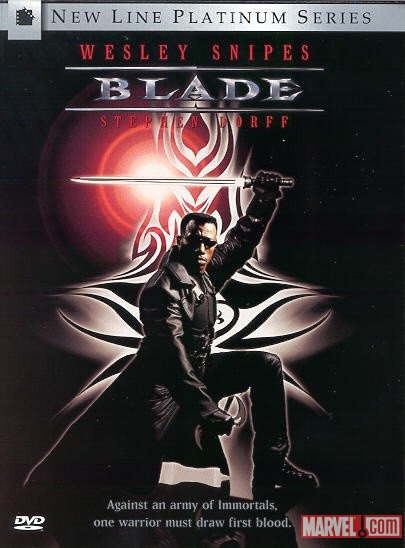
The first Blade movie, released in 1998, was the pinnacle of action movies for me for a very very simple fact: Blade used a sword. Obviously, right? I mean, his damn moniker is Blade. But, well, I was also 11 in 1998 (and while I didn't watch the movie when I was 11, I did see it while it was newish) so I was easy to please. I still am, but that's beside the point. As I've grown, I can still appreciate the first Blade movie, and do, even despite the flaws, and I'd still go out and say that it's one of the better action movies of its type; certainly one of the better Comic-to-Film adaptations as well.
Why though? Well, the cast is fairly well-done: Wesley Snipes, even though he may not be the best guy to work with, and you certainly don't want him managing your money, plays the character they wanted him to be very well. As far as the movies go, Blade is obviously supposed to be the cool, confident, badass guy who wins, even when it looks like he may not, and he pulls this off well, so that even when he's been weakened by the Vampiric Thirst (which he subverts with a manufactured serum his mentor, Whistler, came up with), you're just watching and waiting for that badass switch to get flipped once more so he kicks back into the swing of things.
| Deacon Frost is amused by his own antics; a Pureblood vampire is about to burst into flames from direct sunlight. |
Rather than listing the characters and their actors as I was going to do, I'll just throw the blanket statement out there that every character manages to convey their archetype without being one-dimensional; a feat to truly be envied by some of these other Superhero flicks. Stephen Dorff is convincingly conniving while showing that he is also a fairly immature vampire, Kris Kristofferson is believable in not only his age and how that bears on his character, but also the impact of his backstory in regards to the fight against vampire kind, and Donal Logue does astounding at being an appropriate foil to Frost; where Frost is serious more often than not, Quinn is truly enjoying the life (or un-life, depending on how your views of Vampires are), and is almost never serious. Where Frost is inflexible, Quinn nearly changes on the fly, and where Frost obviously has plans, Quinn is just the guy who's there to help out when it's convenient. If nothing else, I can honestly tout that they did characterizations correctly, which I've just gone on about for two paragraphs now.
But that wasn't all it did right; there was a very real style to the movie and one that was consistent with itself. The camera angles and the general mood throughout never felt disjointed, there was no jumping about, and everything was done with consideration to the rest of it. The big example of this that comes to mind is how the workshop is shown off; whenever it's introduced in the movie, you always get a feel for just how big it is, and that never changes. So near the endpoint, when you're given Whistler's Last Stand and then apparent demise, it's not hard to imagine that he was so easily surprised and taken down. They could have been hiding just about anywhere before they finally sprung out into action.
The choreography is top-notch as well, as the fight scenes rarely get too indulgent, too flashy, but still remain impressive. It's hard to find a movie these days as far as action goes that doesn't try to incorporate some sort of wire-fu, CGI and/or bullet time anymore which is a real shame as those tools are really just crutches that should have been cast-off almost immediately. They might have been fine for their originators, and some things have incorporated them well, but as a standard, they're almost unnecessary and end up detracting more than they add. Though CGI is used quite liberally in the end-fight, it's really the only example, and it's used less for the fight and more for the flash.
In all, Blade is, in my opinion, one of the quintessential Action movies from that era, and, as I've mentioned, assuredly a quintessential Comic/Superhero movie that is a need-to-watch if you're interested in either. It hasn't aged poorly, I'd say, because it doesn't rely too much on effects or the like (outside of Vampires crumbling), though the ending animation of Frost bulging out and eventually exploding, thanks to CGI, may be a bit laughable. YMMV on that.
So, reading all that, you may be wondering,
How did it go wrong?
And the answer is really quite simple: They made a sequel.
Sequels are never inherently bad. That has to be said and truly, a sequel to Blade didn't have "bad" written on it on principle. But, while not being bad bad, it did manage to differentiate itself from the first movie in ways that aren't, well, good. For starters, the character of Blade was changed; while still a definite badass even when he's not, he also had a little comedic effort pushed onto him which was wholly unnecessary, and though there's no indication that he's much of a team player or a leader, he's thrust into both roles and basically excels in them for little reason, despite the odds stacked against him. Not only is he leading a group of Vampires, but he's leading a group of Vampires that exist solely to destroy him and are only working with him because something 'worse' has reared its ugly head.
Which, if anything, that would be what would make someone shy away from a Blade sequel, would be the fact that a sequel generally tries to one-up the first in ways that it doesn't really need to, in an attempt to ensure it's not painted as "the same film, but different". After all, why make a sequel about Blade killing vampires, when he could be killing different vampires, the Reapers, is what I imagine the general thought was behind it. The first movie's plot didn't really lend itself to a sequel in its' nature: Deacon Frost stumbled upon an ancient prophesy and works towards fulfilling it to gain ultimate power, succeeds, and is still thwarted by Blade. Of course reading that, you can't say "Well, that again in different ways would be so much better or just as good!" because it's not built for a re-do. But the answer to that isn't "The head vampire made a new strain of vampire with science and it went totally wrong" in the classic Man vs. Machine plot archetype.
| Jared Nomak, sympathetic villain, and straight up ugly as sin. His chin opens up into a second mouth, if you're curious about the seam there. |
While not a machine, Jared Nomak is a created being, and thus fills the role well enough for a comparison. The reapers, as is quickly shown in the film, are unique in that A) They don't give a damn and will not only drink, but be sustained by human -and- vampire blood, but B) they are more unsustainable than normal Vampires as they're likened more to Crack Addicts in their need for blood and in fact, die out much faster and more dramatically than normal vampires from thirst. Which should be a red flag as far as their supposed role as the true vampire successors goes, as was the intent of Damaskinos in creating Jared, or rather, making Jared a Reaper. The goal being, more or less, to create Daywalkers like Blade; all the strengths, none of the weaknesses. And while the Reapers developed an immunity to garlic and somewhat to silver, as well as an arbitrary skeletal upgrade to make staking them more difficult, the sensitivity to sunlight/UV light was cranked way up to a degree that borders on insulting to the viewers.
In the end, what you end up with in Blade II is less Blade and more Dawn of the Dead; the Reapers are too much like zombies in their single-mindedness for blood, only showing brief flashes of anything that could be considered a higher brain function, despite the fact that Nomak is smart and likely stronger than most of the other characters in the movie, and the movie itself is too wrapped up in showing a team against this 'crisis' rather than showing Blade just kill a lot of them and be completely badass. On top of that, there's a 'reveal' section of the movie, where there's about two too many face-heel turns and double/triple-crossings that ultimately just exist to get rid of characters. Which Blade II is really, really concerned with doing.
| Most of the Bloodpack. I would say the ones that do more than suck and die, but, well, Verlaine and Snowman are in it. |
Within minutes of revealing The Bloodpack, the 'elite team' of Vampires put together with the intention of killing Blade, the numbers start dwindling after being shown just how poor they really are. Not only are two of their members not much of a match for Blade together, but they're quickly beaten into submission with mind-games and a sort of insurance policy administered following the typical "Group superiority Mentality" moment. And all in all, only about two of them amount to anything before dying. They exist almost solely to show that they had a varied group ready to take Blade on, and then to die unceremoniously to random Reapers for being overconfident, vain, or just plain stupid.
For example, Lighthammer, the stereotypical "big guy who doesn't speak the same language as anyone watching the movie" character gets into a one-on-one with a Reaper, gets bitten and, rather than admitting it or dying, merely covers the wound and, I guess, tells himself that logic be damned, he wasn't going to turn into one of those. He then goes on to turn into one in the very next battle, kills Snowman (the mute samurai of the group who does absolutely nothing prior to this point) and tries to kill his girlfriend, Verlaine, who kills him and herself by exposing them both to direct sunlight. That's three members of the Bloodpack dead in ways that not only could have been avoided (Snowman was even killed off screen), but are, honestly, arbitrary. Their inclusion just seems like padding.
In the end, after a lukewarm love sub-plot is extinguished, the movie just sort of ends after a great call-back to the start of the film. It was a wacky adventure and then it was over simply because every single person involved, Blade excluded, was dead.
And then, well......and then They made a third.
In one of those moments where you can only go "wait, what, how did that happen?" Blade Trinity was announced, and right away, it's clear that they didn't learn their lesson. The team aspect was back and though arguably better-executed this time, more members of it than not were frivolous at best still, and it again boiled down to only a few mattering whatsoever. The film then continues on to destroy the semblance of universal continuity with the other two movies and, instead of portraying the war between Humans and Vampires as something that happened on an underground basis as it had been, brought it directly into the forefront of everyone's minds. The film basically starts with a talk show of people talking about vampires and Blade in a way that just shatters everything created by the first film and especially the second.
Early on, Blade is tricked into killing a human (a familiar, but whatever) which is played up to be a bad thing, which, given that there's a focus on the police and the media for that very specific area of the film, is understandable. And then almost immediately, Blade informs the viewers (and a psychiatrist who borders on schizophrenic) that he's done it 1,161 times prior. All of them familiars as well. Just that, well, he wasn't on tape those times, apparently.
| The three best parts of Blade: Trinity. |
Essentially, the movie is everything the first is not; I said the first had a specific style and stayed consistent throughout, whereas Blade: Trinity hearkens back to the ages of Evil Dead 2, where the horror genre was so over-the-top it started making fun of itself, and makes a mockery of just about everything involved. It's hardly even consistent within itself, much less than with the Universe it had created with the first two films, and jumps around entirely too much. At the start of the film, the 'bad guys' uncover Dracula's tomb and reawaken him and bring them back to their corporate office, er, I mean, secret lair, and at one point it's mentioned that that was months prior than when the bulk of the movie takes place, despite no real time lapse being shown or even hinted at. Nor is it relevant at all.
The plot moves in a way that if you stop paying attention, as you are wont to do during action movies, you actually will get lost, as the bulk of it is touched on, then never mentioned again. The group Blade ends up working with after Whistler is killed within the first twenty minutes of the movie, the Nightstalkers, has come up with a bioweapon that will take out every vampire in the world just because but they need a perfect sample of vampire DNA or something, which, despite some Vampires being able to procreate and create pure blood vampires, means they need Dracula's blood. And by they need Dracula's blood, they mean they can create the weapon, but it needs to touch Dracula's blood before it goes into the air and then apparently spreads throughout the entire world. So that's what they do; they put the weapon (which is a vial of some sort of liquid) in a special arrow shaft and give it to Abby Whistler (as in Whistler Whistler, she's his illegitimate daughter, which just ruins his character's remorseful and resentful nature towards his family being killed by vampires) and say "Shoot Dracula with this".
She tries and, as anyone could have expected, given that it's freaking Dracula, fails when he whips around and grabs the arrow right out of mid-air, dropping it afterwards because, well, why would he destroy the MacGuffin, I guess. And then Blade being, well, Blade, grabs it, stabs him with it and wins for all mankind somehow and survives because he's Blade. (Also a half-vampire, but, well, I guess not enough half or something, as he stays half-vampire) With his dying breaths, Dracula congratulates Blade on defeating him and gives his respect, but warns Blade that "the thirst always wins". Drained from the fight and affected somewhat by the bioweapon, Blade passes out, and then promptly awakens during his autopsy and almost immediately appears to be turned to the way of blood-sucking (specifically, stalking towards one of the nurses menacingly) before the movie just ends.
As a series, Blade starts well before clearly going off its own tracks and then flying directly into a city for a glorious train-wreck. I will say that all three movies are entertaining, which is key, but by no means is the third good, and the second even, is questionable in this aspect. You could certainly do worse things with the time that one spends watching all three movies, and there are plenty of lesser quality movies you could watch, so if you're looking to be entertained by Action and then less action and more Comedy, the Blade Trilogy should be right where you want to be. But if you're looking for a series that exemplifies what a comic book movie should be, well, you know where to stop watching.
Subscribe to:
Posts (Atom)